
What is Weld
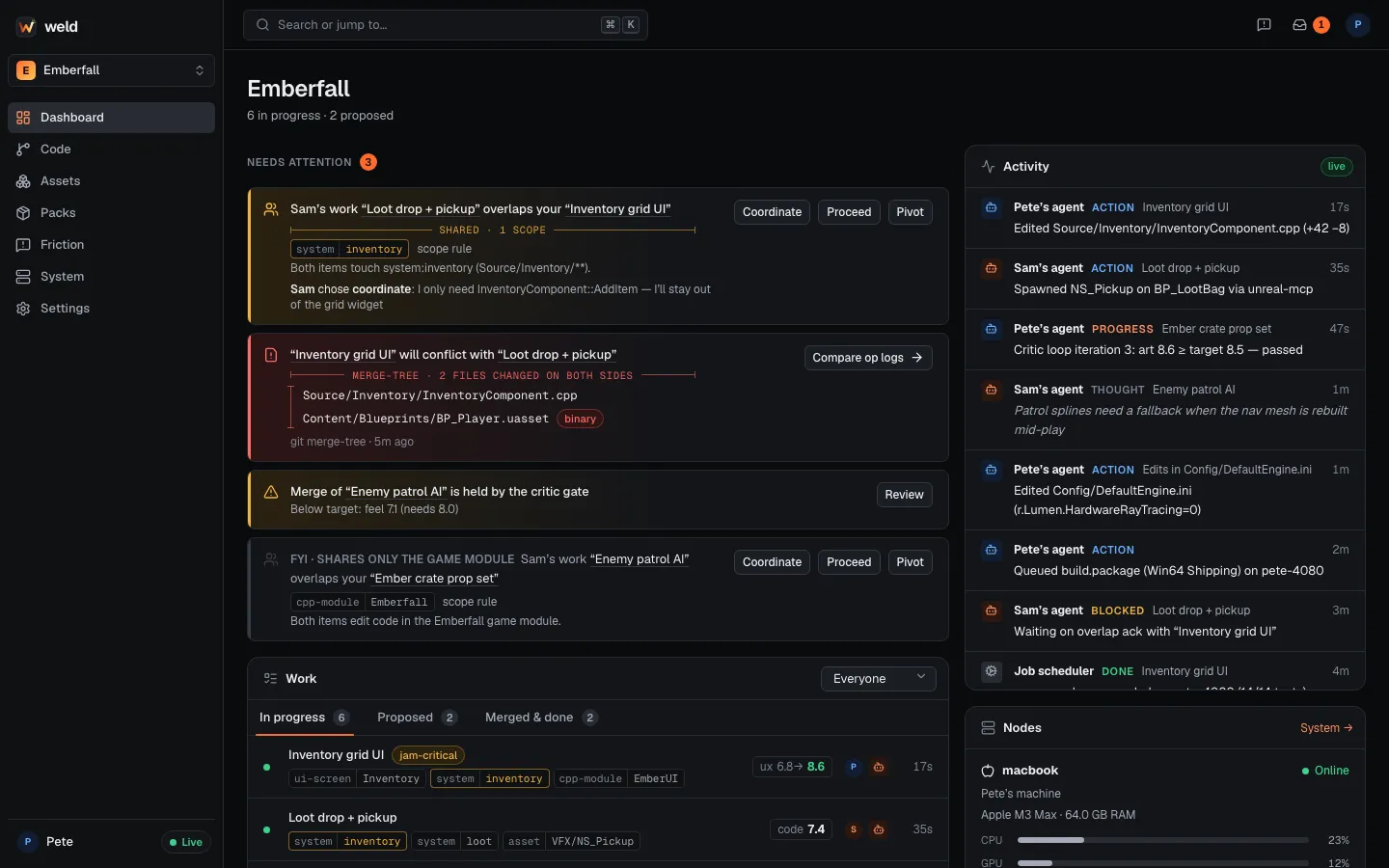
Weld is a coordination layer for small teams who build games mostly by driving Claude Code agents. Two to a handful of people, each running one or more agents on their own machines, work on the same Unreal Engine project at the same time. Weld keeps everyone, human and agent, aware of what everyone else is doing, so the work fits together instead of colliding.
The problem it solves
Section titled “The problem it solves”One agent is a superpower. Several agents on one codebase, driven by different people, step on each other: two of them build the same feature in different ways, a binary Blueprint is edited on both sides, a merge goes wrong on Friday night and nobody notices until Monday. The usual answers (file locks, stand-ups, “don’t touch my folder”) take away the speed that made agents worth using.
Weld takes a different approach:
- Anyone can edit any file, as in plain git. Weld prevents feature collisions, not edits.
- Every piece of work is visible. Agents declare what they are building as a Work item, and Weld shows it to everyone in real time.
- You are asked once. When two Work items touch the same area, Weld raises an overlap and asks the human one question: coordinate, proceed or pivot. After that, nothing blocks.
- Conflicts are predicted, not discovered. Every node pushes its in-progress work to the hub
about once a minute, and the hub runs a real git merge between every pair of active branches,
so you hear “this will conflict with Sam’s work in
InventoryComponent.cpp” while there is still time to talk. See WIP refs and conflicts. - Merges are handled. A merge queue on the hub runs your tests and quality gates, and a merge agent resolves text conflicts using both Work items as context.
- Quality is measured. A critic loop scores each iteration against your own rubric with fresh-context critics, and the merge gate respects the scores.
How it fits together
Section titled “How it fits together” Claude Code ── MCP + hooks ──┐ ┌────▼──────────┐ ┌───────────────┐ Unreal Editor ◄── MCP ──│ weld (node) │ │ teammate node │ Blender (headless) ◄────│ on your Mac │ │ or GPU PC │ git / Git LFS ◄─────────│ or PC │ └───────┬───────┘ └──────┬────────┘ │ one outbound HTTPS + WebSocket per machine │ ┌──────▼───────────────────────────▼──┐ │ weld-hub: Work, overlaps, conflicts, │ │ inbox, merge queue, jobs, packs, │ │ assets, git + LFS hosting, telemetry │ │ and the web dashboard │ └──────────────────────────────────────┘- The hub is the single place your team shares: it hosts the game’s git repository and large files, keeps the list of Work, runs the merge queue and serves the web dashboard. Your team runs it on a spare machine or a small server.
- A node is the
weldprogram running on each person’s machine. It connects Claude Code (through hooks and an MCP server), Unreal, Blender and git to the hub, and runs jobs such as builds and 3D generation. - Claude Code stays your main interface. The Weld plugin adds context at the start of each session, declares Work, surfaces overlaps and conflicts, and gives the agent tools to hand off work, message teammates and merge. See Using Weld with Claude Code.
What else is in the box
Section titled “What else is in the box”- An AI asset pipeline: concept image, image-to-3D on your own NVIDIA GPU, headless Blender cleanup with LODs, and Unreal import, with a human approval at each of three gates and license-checked provenance on every asset.
- Builds and shipping: package the game on whichever machine fits,
smoke-test it headless and upload it to itch.io with
weld ship. - Packs: knowledge, workflows and agent definitions shared through the repo, so a lesson one agent learns is available to every session after it merges.
- Doctor:
weld doctorchecks the whole setup, fixes what is safe and hands anything left to Claude Code with a diagnostic bundle. Every error has a stable code with a cause and a fix. - Observability: costs, tokens, logs and health for every person, agent and machine, in the
dashboard’s System page and
weld ops.
What Weld is not
Section titled “What Weld is not”- Not a replacement for Claude Code or Unreal. It connects them. Your agents run under your own Claude Code subscription on your own machines; Weld never resells model usage, and AI work never crosses from one person’s account to another’s.
- Not a lock server. No file is ever locked. Binary assets are kept safe by predicting conflicts early and by keeping both versions when they happen.
- Not a cloud service you hand your game to. Code, assets and telemetry live on your team’s hub.
Who it is for
Section titled “Who it is for”Small teams, two to a handful of people, building an Unreal Engine 5 game (C++ with Blueprints) on Mac and Windows machines, each person with their own Claude Code account. The asset pipeline needs an NVIDIA GPU with 12 GB or more of VRAM somewhere on the team; everyone else sends it jobs.
Weld is in private beta. If you have been invited, continue with Getting started.